MagicSim: A Unified Infrastructure for Executable Embodied Interaction
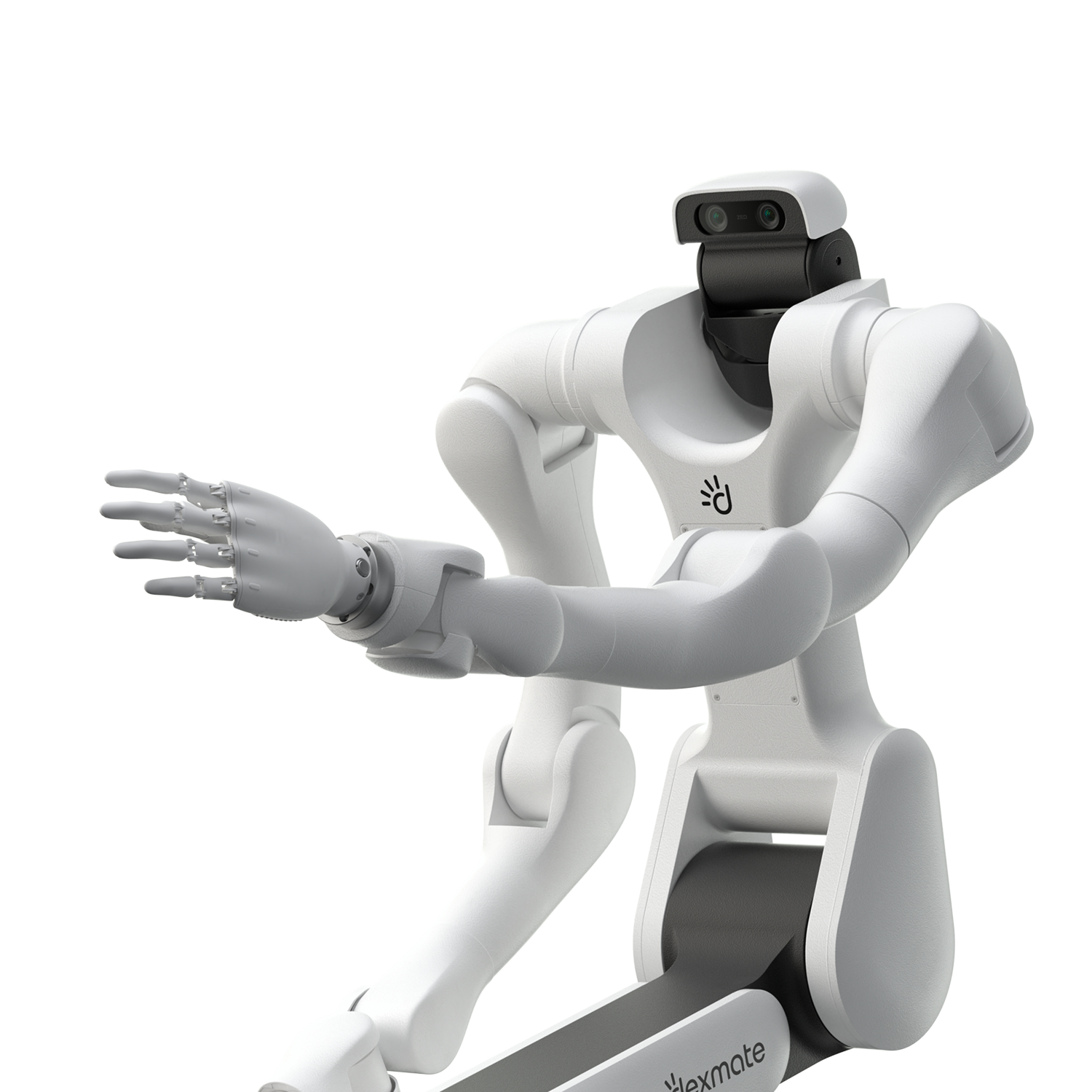
Northwestern, Peking University and partners build a single simulation runtime where benchmarks, automatic data collection and agent interfaces share one execution loop. A Vega 1 Pro with Sharpa Wave hands is one of its ready-to-run mobile manipulator embodiments.
- 1Northwestern University
- 2Peking University
- 3University of California, Berkeley
- 4ShanghaiTech University
- 5Institute of Automation, Chinese Academy of Sciences
- 6University of Chinese Academy of Sciences
* Equal contribution · † Corresponding author
arXiv preprint arXiv:2606.17511
Abstract
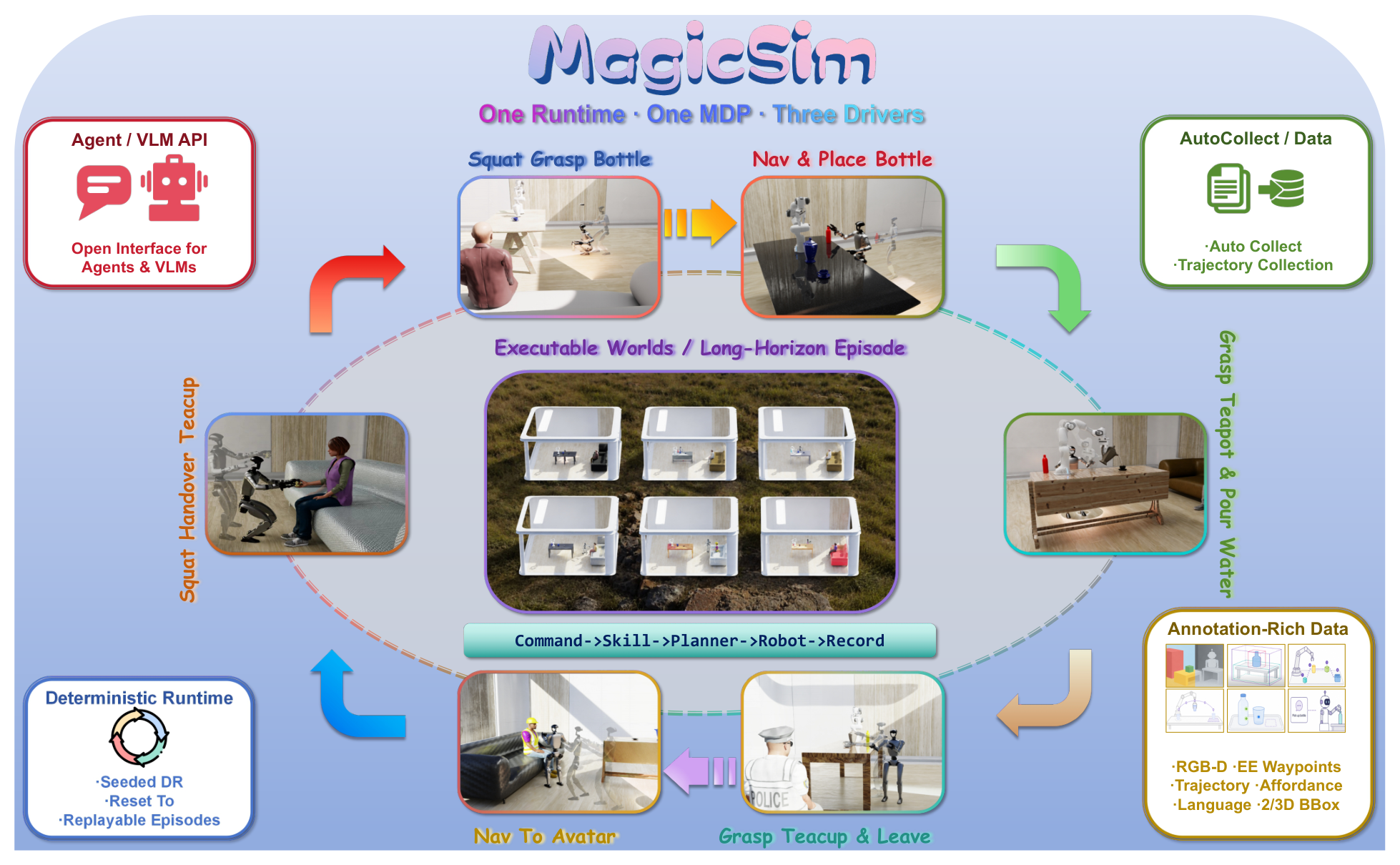
Robot learning and embodied agents now require simulation to serve as a shared execution substrate linking control, skills, and planning, not only as a renderer, controller testbed, or fixed task environment. Existing pipelines split these layers with "magic" actions, disconnected training environments, or forward-only renders that cannot reproduce, evaluate, and annotate the same episode. We present MagicSim, an embodied interaction infrastructure built around one deterministic batched runtime and a shared Markov decision process (MDP). From YAML-first specifications that decouple contents, placement, behavior, and agent exposure, MagicSim constructs diverse executable worlds spanning task families, interaction regimes, physics, layouts, sensors, avatars, and robot embodiments in one reset-and-step loop. A common execution interface grounds high-level commands through controllers, atomicskills, planner primitives, and asynchronous planning, realizing them as robot actions rather than simulator-side state edits. One task definition supports three capabilities: benchmark and RL evaluation, an autocollect interface that automatically turns commands into grounded trajectories, and agent/VLM-facing interaction. For automatic execution, commands flow through a Command->Skill->Planner->Robot->Record pipeline, while per-environment command, skill, planning, retry, annotation, and episode states advance independently above the shared physics tick. Successful rollouts are saved as structured multimodal trajectories aligning language supervision, action representations, visual/geometric representations, and task-level status with the executed episode. MagicSim thus unifies diverse world construction, embodied execution, task evaluation, automatic rollout generation, and interactive agent interfaces in one planner-in-the-loop runtime.
Citation
@misc{lu2026magicsimunifiedinfrastructureexecutable, title = {MagicSim: A Unified Infrastructure for Executable Embodied Interaction}, author = {Haoran Lu and Songling Liu and Yue Chen and Guo Ye and Mutian Shen and Shuyang Yu and Yu Xiao and Shang Wu and Jiayi Wang and Jianshu Zhang and Jihai Zhao and Xiangtian Gui and Chuye Hong and Yuran Wang and Maojiang Su and Ruihai Wu and Zhaoran Wang and Han Liu}, year = {2026}, eprint = {2606.17511}, archivePrefix = {arXiv}, primaryClass = {cs.RO}, url = {https://arxiv.org/abs/2606.17511}, }Start Your Physical AI Journey with Us