PGDG: Robust Bimanual Policies from One Demonstration
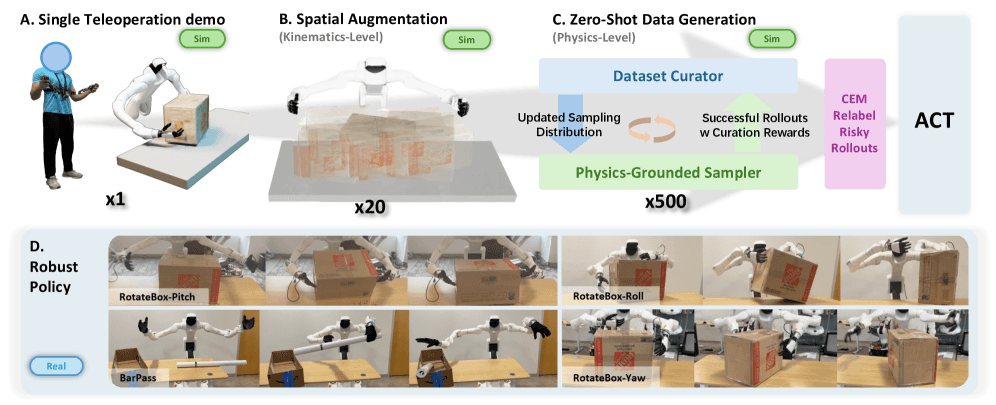
Dexmate and Carnegie Mellon expand one teleoperated demonstration into a full training set by simulating physically plausible variations, so the resulting bimanual policy can recover when things go wrong.
PGDG: Physically Grounded Data Generation for Robust Bimanual Policy Learning from a Single Demonstration
- 1Carnegie Mellon University
- 2Dexmate
† Equal contribution
arXiv preprint arXiv:2605.21710
Abstract
Behavior cloning for contact-rich bimanual manipulation remains challenging because diverse demonstrations are expensive to collect, and even small disturbances can push the system into off-manifold states where no recovery supervision is available. We propose PGDG, a data generation framework with zero-shot curation that expands a single demonstration into a compact dataset of physically plausible, successful, and diverse recovery behaviors without additional human labeling. PGDG iterates between a physics-grounded sampler and a dataset curator, where the curator selects informative, non-redundant, and recoverable behaviors to update the sampling distribution toward under-covered recovery modes, and the sampler draws physically plausible rollout candidates from this updated distribution and retains successful trajectories. To further improve data quality, PGDG applies short-horizon sampling-based control to relabel selected risky states with corrective actions. Across four bimanual manipulation tasks, PGDG consistently outperforms spatial-only augmentation in both simulation and zero-shot real-world transfer. On RotateBox-Pitch, success improves from 38% to 93% in simulation and from 35% to 82% in the real world. PGDG also enables effective foundation models fine-tuning such as GR00T, increasing success from 46% to 77%. Additional results are available in our website: https://cunxid.github.io/PGDG/.
Citation
@misc{dai2026pgdgphysicallygroundeddata, title = {PGDG: Physically Grounded Data Generation for Robust Bimanual Policy Learning from a Single Demonstration}, author = {Cunxi Dai and Haoran Chang and Aditya Nisal and Rahul Kumar and Guofei Chen and Tao Chen and Yuzhe Qin and Guanya Shi}, year = {2026}, eprint = {2605.21710}, archivePrefix = {arXiv}, primaryClass = {cs.RO}, url = {https://arxiv.org/abs/2605.21710},}Platform
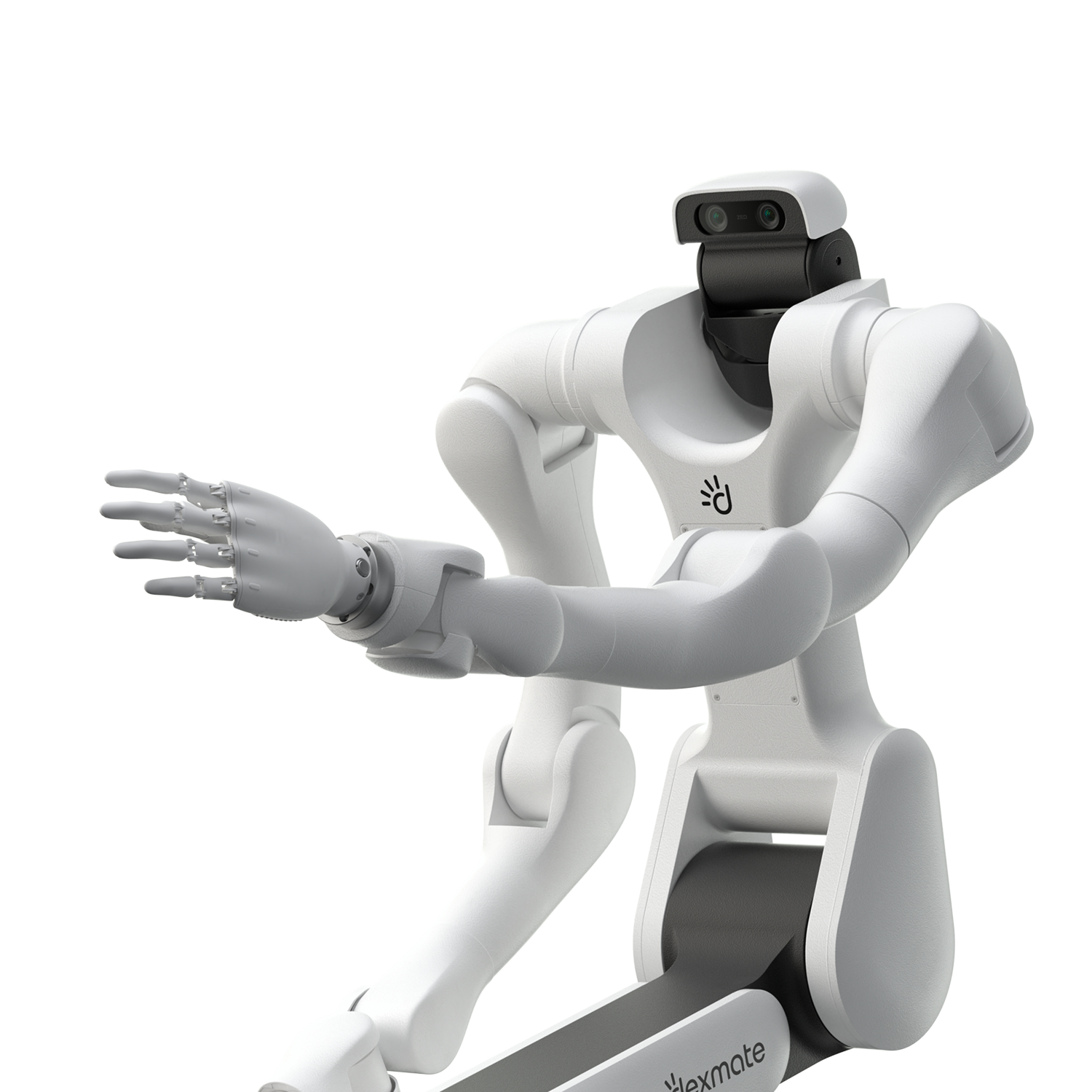
The write-up describes the robot only as a bimanual mobile manipulator with two 7-DoF arms and wrist force-torque sensors. That robot is a Dexmate Vega, and the single source demonstration was collected with a wearable exoskeleton. Policies trained on the generated data ran on the real robot with no further tuning, 40 trials per task. Vega is available today as Vega 1 Pro and Vega 1 U. See all research papers published on Dexmate robots.
Related Research Papers
Start Your Physical AI Journey with Us